Brand & Prompt Framework: Governing your brand in the AI era

Executive summary: understanding how brand governance works today
In an era where generative AI and personalization engines reassemble brand assets at scale, the traditional model of human gatekeepers reviewing outputs one by one is no longer sufficient. Rather than disappearing, the role is being transformed. Brand leaders move from output reviewers to constraint designers, from policing the surface to architecting the very infrastructure that governs it.
To remain consistent, leadership must transition from aesthetic guidelines to encoded brand constraints. An encoded constraint is a specific, testable rule that always acknowledges a customer’s frustration before explaining, in every system, without exception. This is the sort of rule that lives in a system prompt, travels through a design token, or sits at the top of a personalization logic stack … and holds without a human in the loop.
- The challenge: Organizations have built the infrastructure to express brands at scale, yet they lack a precise, machine-readable definition of what should be expressed.
- The solution: Implementing the Brand & Prompt Framework, a three-layer system that defines invariant logic, translates it into encoded expressions for AI systems, and allows for high-quality emergent experiences.
- Strategic outcome: Moving brand ownership from the marketing surface to the infrastructure layer ensures a consistent pattern of experience that builds long-term customer trust.
When AI reassembles your brand on the fly, and every customer sees a different version of it, there is one key question: what exactly is the brand?
For decades, the brand was protected by scarcity. There was a finite number of touchpoints with human gatekeepers at every single one: designers, writers, and strategists who had internalized what the brand meant and could be trusted to express it consistently. Nowadays, that model is gone. It’s not under threat … it’s already disappeared.
And that’s because generative AI doesn't interpret your brand. It reassembles it from fragments of your tone-of-voice guide, your website copy, your product descriptions, and your customer service transcripts into something that is recognizably adjacent to your brand … all at a scale and speed no human team could possibly match.
When it comes to personalization, generative AI isn’t limited to delivering a single brand to your audience; it presents a different version to each person, optimized for their behavior, context, and predicted next action.
That’s where the concept of “the surface” comes in. It is what customers see, and in an AI-mediated world, it is permanently in motion. Generated, personalized, optimized, reassembled. No two customers encounter exactly the same brand, nor is any output quite like the last.
If every customer encounters a different AI-assembled version of your brand, who exactly owns it?
It’s important you view this not as a rhetorical question, but as an operational one. In our work with enterprise clients, we find that most organizations lack an answer.
The honest diagnosis is this: we have spent years building the capability to express brand at scale, and almost no time defining what exactly should be expressed. We have very sophisticated pipes and a surprisingly vague idea of what should flow through them.
The three questions that matter now for brands

What is the brand when the surface is always changing?
Not the visual identity, nor the tone of voice.
It’s the constant beneath both: the logic that holds regardless of medium, model, or moment.

Who governs the brand when AI is the author?
Not the CMO nor their sign-off on a campaign.
Structure governs through rules encoded deeply enough that the brand holds, even when no human is in the room.

How do you hold a brand together across infinite variations?
Rather than by controlling every output, it’s by defining what cannot vary and encoding that deeply enough that the variation stays within it.
At the base of it all, the answer to all three is the same.
Brands need to become something they’d never had to be before: a system of constraints precise enough to govern outputs they will never directly author. Not a mood board, not a manifesto, but a set of governing decisions that are stable, explicit, and testable. Your role is to clearly define what your brand is and is not, what it will and will not do, regardless of who or what is expressing it.
In a world of constant flux, brands are only real if they’re defined at a level that holds steady.
The Brand & Prompt Framework in three layers
The Brand & Prompt Framework contains three layers; the first makes the other two coherent, and yet most organizations have only the third.
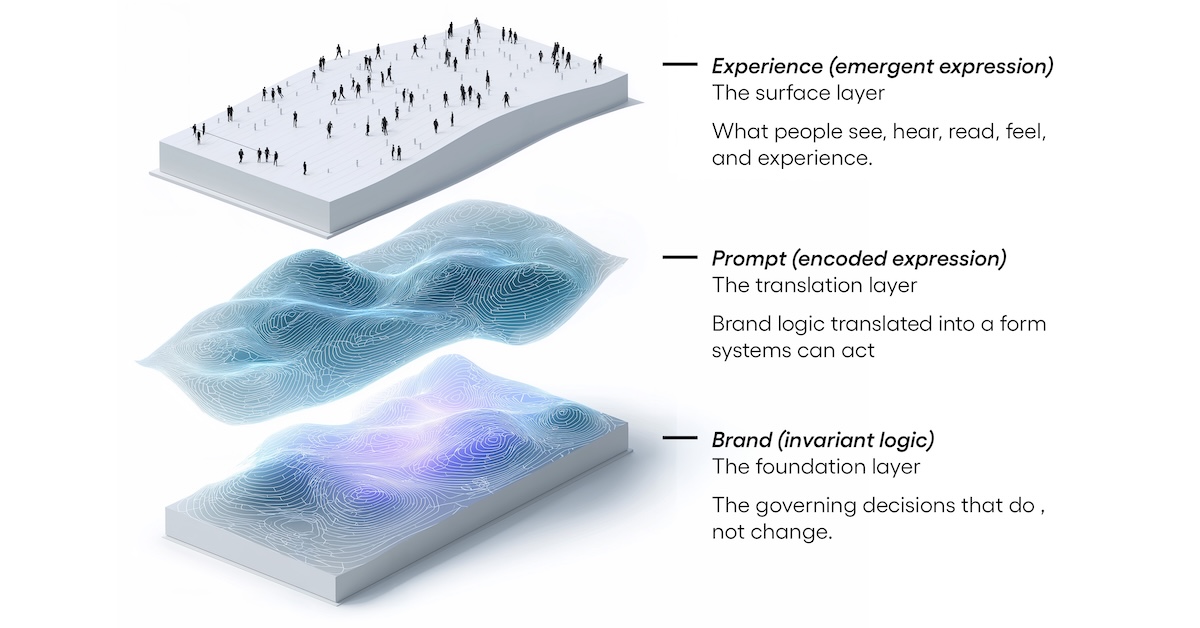
Let’s dive in:
1. Brand (invariant logic): The foundation layer
These are the governing decisions that do not change: what the brand prioritizes under tension, what it refuses even when opportunities present themselves, how it behaves at the edge cases that define character. This is not the style guide; it is the logic the style guide was trying to describe. It must be defined explicitly enough to constrain a system that will never read between the lines.
2. Prompt (encoded expression): The translation layer
This is brand logic translated into a form that AI systems, personalization engines, design systems, and CX architectures can act on. Modular, versioned, testable, rather than a tone-of-voice addendum. The brand library and the prompt library are unified into a single source of truth that every system taps into, expressed differently for each consumer but drawn from the same invariant core.
3. Experience (emergent expression): The surface layer
This is everything customers encounter across AI outputs, personalized communications, CX journeys, interface interactions, agent conversations, and beyond. The experience is not designed at this layer; instead, it emerges from the quality of the two layers beneath it. Building experiences without a defined brand foundation and coherence is accidental, fragile, and increasingly expensive to repair.
Our approach to building brands using the Brand & Prompt Framework
Step 1: Audit
Find the brand that already exists beneath the guidelines. Every brand has a logic that shows up in the decisions that were made consistently, under pressure, and over time. It’s the executed logic, not the planned one visible in the brand values deck, for instance.
The audit inspects the existing brand: what it has always prioritized, where it has never compromised, what it would not do even when a competitor would. This is the raw material that most organizations find more specific and more interesting than anything they wrote down.
Step 2: Define
Turn brand character into brand constraints, always bearing in mind one key guideline: adjectives are not constraints. “Human, expert, bold” describes a desired feeling, yet it does not tell an AI system what to do when those values are in tension. A constraint does; for example, if the customer is frustrated and the context is pricing, lead with directness and it comes second, every time, in every system.
Defining this means going further: conditional logic, edge-case decisions, and the hierarchy of what matters most when the brand can't have everything. This is where brand becomes something a system can act on.
Step 3: Build
Encode the brand across every system that now speaks for it: the AI model, the personalization engine, the design system, the CX principles, the agent's governing logic. Each of these has become a voice of the brand, and each one now carries a different, locally-maintained interpretation of what that means.
The Brand & Prompt Framework replaces that fragmentation with one encoded source: the brand as a system of record, expressed differently for each consumer but drawn from the same invariant core.
Step 4: Govern
Own the brand layer the way you own infrastructure, always bearing in mind that brand evolves, models are replaced, and touchpoints multiply faster than any team can review.
Governance means treating the encoded brand as living infrastructure—infrastructure that is versioned and owned, with clear processes for when it changes and clear accountability for when it drifts. The organizations that do this well produce consistent brand experiences, not because they review more outputs, but because the system is governed at the source.
Why does brand governance matter?
The stakes here are not merely aesthetic. A brand that cannot govern its own expression across AI systems is not just visually inconsistent … it is strategically exposed.
Because what customers trust is not the campaign, it’s the pattern of experience over time. And that pattern is now assembled, at scale, by systems that have no inherent interest in whether it holds.
The brand that survives AI is not the one with the best visual identity; it’s the one that defined itself precisely enough to remain coherent across every system that now speaks in its name.
The Brand & Prompt Framework is a foundation and program of work for organizations navigating brand governance in the age of AI-mediated experience.
Secure your brand’s future in the AI era and transition your brand governance from the surface to the infrastructure layer, effectively ensuring strategic coherence at scale. Learn more about how we can help, and how the Brand & Prompt Framework can unlock a future-proof brand.
Frequently asked questions
How do you govern brand identity when AI is the author?
Governance in an AI-mediated environment requires shifting from manual review to structural, encoded constraints. Instead of CMOs signing off on individual campaigns, they must govern the system of record, the underlying brand logic that AI models and personalization engines draw from to ensure outputs never deviate from the core brand character.
What is invariant logic in brand strategy?
Invariant logic refers to the foundational governing decisions that do not change, regardless of the medium or model used. It defines what a brand prioritizes under tension and how it behaves in edge cases. While a style guide describes visual appearance, invariant logic describes the underlying character that the style guide was attempting to represent.
How can enterprise companies prevent brand drift in personalized CX?
Brand drift occurs when local systems or AI models interpret brand values differently. To prevent this, companies must unify their brand and prompt libraries into a single, versioned, and testable source of truth. This ensures that every customer experience, while personalized to their context, is drawn from the same stable core of brand constraints.
Why is traditional brand management failing in the age of generative AI?
Traditional brand management relied on human gatekeepers and a finite number of touchpoints. Generative AI reassembles brand fragments (copy, transcripts, and descriptions) at a speed that makes human review impossible. If the brand is not defined precisely enough for a machine to act on it, the resulting customer experience becomes fragmented and strategically exposed.
What’s the difference between a brand value and a brand constraint?
A brand value describes how you want to feel: "bold," "warm," "expert." A brand constraint describes what to do when values compete. "Be bold and warm" tells a human writer something. It tells an AI system nothing. A constraint tells it something: if the customer is frustrated and the query is about pricing, prioritize directness over warmth, acknowledge before explaining, and never deflect. That's a rule a system can act on. That's what invariant logic means in practice.